
The Alexandria Current Owner Record Card
The Real Estate Assessment Search gives the current tax-roll view of an Alexandria parcel. Enter the address to open Property Details. The owner field appears there beside the situs, the mailing address, the account number, the map number, and any displayed sale or deed reference. Searching works by address, account number, or map number. The public interface does not offer a separate owner-name tab, so it is built for parcel lookups rather than a broad people search. Its strength is a parcel-specific owner record tied to the assessment.
| Owner of record | Name carried on the assessment roll |
|---|---|
| Vesting | How title is stated in the recorded deed |
| Mailing address | Destination for tax correspondence |
| Situs | Location of the assessed parcel |
| Account / map number | Assessment and GIS reference keys |
| Deed reference | Instrument and date to verify with the Clerk |
The current owner of record is not always the current occupant. A mailing address may sit elsewhere because it is where tax notices are sent. Treat it as a records field, not an invitation to contact someone for unrelated reasons.
How Current Is the Alexandria Owner Field?
The assessment portal states that assessment information refreshes as of Friday each week. Tax details update each business day. A sale recorded with the Clerk can take roughly 30 days to surface. The assessment sales display pulls it in after that lag. These are update notes, not a guarantee that every transaction lands on a fixed date.
After a recent closing, the newest recorded deed may show the grantee. The tax-roll owner field catches up later. Note three dates: the query date, the deed record date, and the assessment data date. If the roll still names the former owner, that usually reflects an update cycle. It is not a missing transfer. When deed and assessment seem to describe different land, compare the legal description and map number. Do this before assuming a refresh issue.
Describe sources precisely. Say the assessment record lists a name, or the Clerk's deed names the grantee. Keep the date with the statement.
Alexandria Deed Vesting Names the Current Grantee
Use the most recent deed matching the parcel to see how title is vested. The grantee may be an individual, joint owners, a trustee, a trust, a company, an executor, or an administrator. The index party name alone is not enough. Read the vesting language and compare the full legal description. A later deed of trust, mortgage, assignment, or release may sit newer in the index. It does not transfer ownership.
An LLC can be checked through Virginia's SCC Clerk's Information System. That gives public entity and filing context. For a trust, search the trust and trustee names separately. For an executor or administrator deed, look for the related estate matter to understand the authority. These checks clarify the recorded party. They do not guarantee every beneficial interest is visible in a public database.
- Owner of record
- The name currently carried in the assessment system.
- Grantee
- The recipient named in a particular recorded instrument.
- Vesting
- The form in which the deed states an interest is held.
- Registered agent
- A business contact, not necessarily a beneficial owner.
Confirm the Alexandria Current Owner with Two Records
Identify the parcel on the assessment roll. Then verify the transfer with the latest recorded deed. Compare the date, instrument type, grantor, grantee, legal description, and account or map number. The newest land instrument may be a deed of trust. In that case, look farther back for the deed that actually conveyed title. When the assessment field names a person but the deed names a trust or LLC, describe the two records separately. Do not force the names into one answer.
- Save the assessment result and its refresh date.
- Search COVERS for the latest deed matching the parcel.
- Read the grantee and legal description in the instrument image.
- Check whether a newer record is only a mortgage, release, or assignment.
The assessor controls the tax-roll owner field. The Circuit Court Clerk controls which transfer instrument was recorded. A complete title opinion requires more than either screen alone.
Alexandria's Newest Land Filing May Not Change the Owner
The newest item in a Clerk search may be a deed of trust, mortgage, assignment, or release. It may not be a transfer deed at all. A refinance can create a later financing instrument while the grantee stays the same. To find the current owner, locate the latest instrument that actually conveys title. Then compare its legal description with the assessment parcel.
Read the instrument type before treating any date as an ownership date. A release clears a described security interest. It conveys nothing. A deed of trust records collateral, not the lender's ownership of the home. The assessment sales table can also lag a new deed by roughly 30 days. So date the newest transfer and the current roll separately.
That distinction keeps the owner of record tied to present vesting rather than to every recent filing that happens to mention the property.
Alexandria Owner Mail Goes to a Separate Address Field
Property Details separates the situs address from the tax mailing address. The situs points to the parcel itself. The mailing field shows where tax correspondence goes. That destination may lie outside Alexandria or be a business address for an entity. It does not reveal who occupies the property. It is also not the deed's legal description.
An unexpected mailing address is not proof of a mismatch. Compare the parcel account and the current deed first. A deed can vest title in an entity or trust. Meanwhile the assessment carries a tax-mail recipient or agent. State the field and the source whenever you describe the current owner record. The Alexandria ownership lookup route lays out the broader address-to-deed sequence.
Alexandria Owners Can Monitor New Deed Activity
Virginia offers a free monitoring tool called VADeed Alert. Alexandria owners can register a name or a tax-map and parcel variation. This tracks new deed and mortgage recordings across the state. An alert is only a signal, though. It does not prove the event touches the right parcel. It never blocks a recording. Before acting, open the underlying COVERS record. Compare instrument type, parties, and the legal description line by line.
The official VADeed Alert service has its own registration screen. Enter name and parcel forms that match how the record actually reads. Then treat each alert as a prompt for source verification rather than a conclusion.
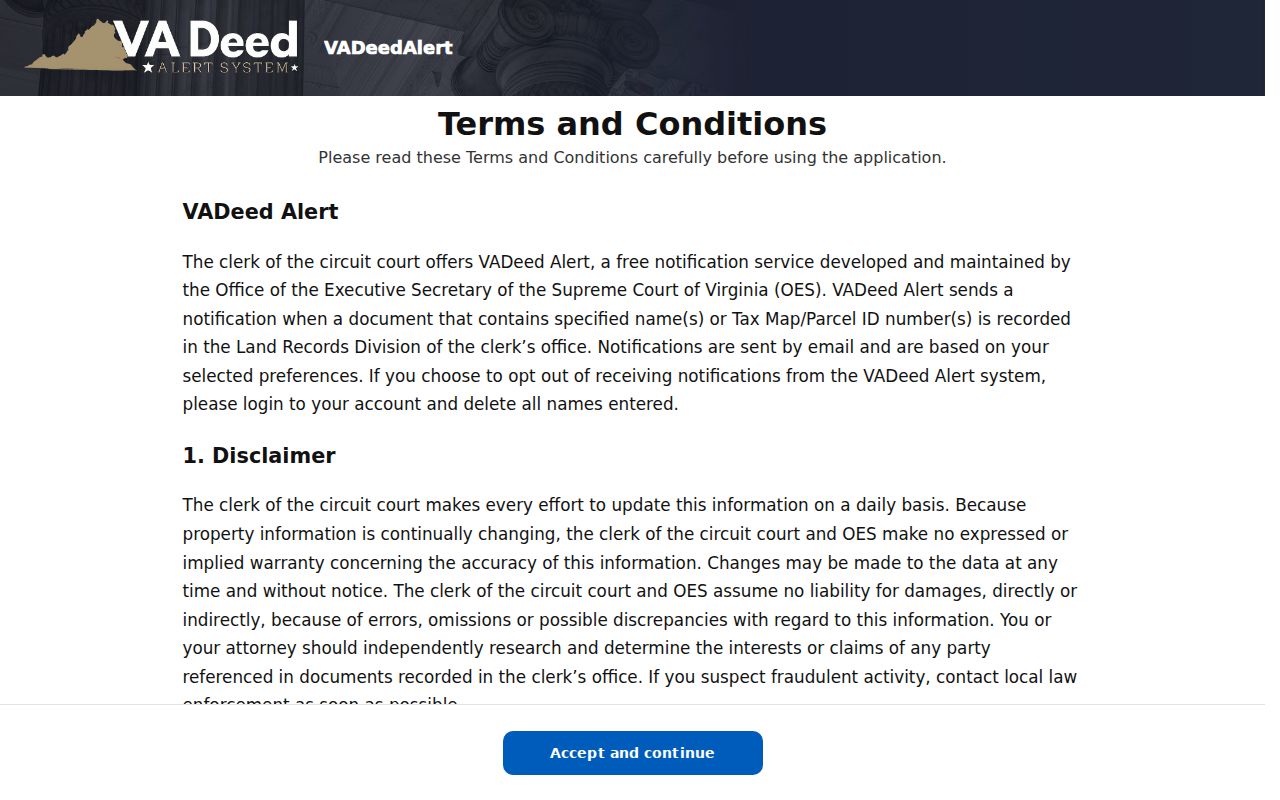
Use any notice to pull the instrument itself, then confirm its parcel description and named parties.
Confirming the Alexandria Current Owner
Start with the assessment roll for the current owner of record. Next, check the Clerk's deed index for the most recent matching deed. Compare the legal description, parcel number, grantor, grantee, and record date across both records. A name appearing only on a financing document is not a transfer. Treat that instrument accordingly.
- Open Property Details from the address, account, or map search.
- Copy the owner field and parcel identifiers.
- Find the latest deed that matches the same land description.
- Check entity or estate records only when the deed's vesting calls for it.
- Owner of record
- The assessment name shown for tax purposes.
- Vesting
- The way the deed names the holder of the stated interest.
- Registered agent
- A listed business contact, which may not be an owner.
Mailing Address and the Alexandria Current Owner
The mailing address on an Alexandria assessment record serves tax correspondence. It often differs from the situs. It may point to an out-of-city location or an entity's business office. The field alone cannot establish who lives at the parcel.
Virginia's Address Confidentiality Program offers eligible participants a designated address with mail forwarding. It is not a blanket removal from every public record, however. Agencies may seek statutory exemptions, and court orders can permit disclosure in some situations.
Lawful use. Treat owner names and mailing addresses as records for property research. Do not use them to stalk, harass, threaten, or harm a person.