
What Alexandria Property Tax Records Show
Every Alexandria property tax record pairs two things: an assessment record and a billing account. The assessment side holds the parcel details. It also holds the value that real-estate tax is calculated from. The account side holds the tax bill, payment history, delinquency status, and any related fees. Each answers a different question. Each can update on its own schedule, too. When comparing them, rely on the stated year and the bill number. That way you are reading matching records.
| Field | What It Shows | Where |
|---|---|---|
| Assessed value | January 1 estimate used in the tax calculation | Office of Real Estate Assessments |
| Land / improvement | Value components and property characteristics | Assessment Property Details |
| Relief status | Exemption or tax-relief application status when shown | Assessment / Finance program |
| Bill and payment | Current and prior charges, payment, and balance | Tax & Fee Info / Treasurer |
| Other account charges | Refuse, stormwater, penalties, and interest | Tax & Fee Info |
The assessment office values property at 100 percent of estimated fair-market value as of January 1, using mass appraisal. The tax bill applies the Council-adopted rate and may include separate service charges. A tax amount therefore should not be read as a sale price, loan balance, or title record.
Alexandria Property Tax Records Use an Eight-Digit Bill Number
Alexandria's public real-estate tax search turns on an eight-digit bill number. That number is not the assessment account number. It is not the map number either. Starting with only a situs address takes a few extra steps. Look up the parcel in Real Estate Assessment Search. Open Property Details, and use Tax & Fee Info to reach the billing details. Or take the bill number from a printed statement. A bill-number lookup shows amounts due and amounts paid. But it will not tell you who holds title to the property.
- Find the parcel in assessment search by address, account number, or map number.
- Save the account and map number, and open Tax & Fee Info.
- Use the eight-digit bill number in the tax search when that is the requested key.
- Review the year, payment date, balance, and separate fees before comparing records.
The City's real-estate tax search is public; the captured screen shows the bill-number lookup.

Payment status is only good for the period displayed. A zero balance today does not wipe out an old mortgage, easement, covenant, or any other recorded interest.
Alexandria's 2026 Tax Rate Example
Alexandria's 2026 example sets the real-estate tax rate at $1.135 per $100 of assessed value. Multiply a $200,000 assessment by 1.135 percent. The result is $2,700 before any separate account charges. That figure belongs to tax year 2026 only. The City adjusts rates and due dates through its annual budget process. Check the current bill before applying the math to any other year.
An assessment notice is not the same document as a tax bill. The notice explains how the assessor set the value. The bill applies the adopted rate and may tack on refuse or stormwater charges. A mortgage company sometimes receives the bill, yet the taxpayer still owes payment. Before deciding two amounts conflict, compare the assessment year, the bill year, and the due date.
The City publishes its real-estate tax calculation and payment information for Alexandria property records research. Finance updates the tax detail each business day, according to the assessment portal's notice.
Alexandria Delinquent Tax Records Need Follow-Up
The tax account can show delinquency, late charges, and interest. The City's page states that late-payment interest begins the day after the original due date. It describes 10 percent annual interest on unpaid tax or late-payment penalty during the first year and 5 percent in each later year; refuse fees carry 10 percent interest and stormwater fees 6 percent. Confirm the current code and tax-year rules before relying on a calculation.
The Discovery and Collections material includes payment plans, a Top 20 Delinquent Real Estate Accounts list through tax year 2023, and collection actions. A listing is a collections lead, not proof of foreclosure or completed sale. The City says real estate may be seized and sold when delinquent as of December 31 following the second anniversary of the original due date. Confirm any property-specific transfer with the recorded deed or order and official auction notice.
Do not treat an unpaid bill as a title transfer. Tax balance, recorded ownership, and a court-ordered sale are separate record events.
Alexandria Property Tax Records Follow the Assessment Cycle
Alexandria's assessment is a mass-appraisal estimate of fair-market value on January 1. Staff group similar property. They study sales. They check physical characteristics. They decide how each group should change. The City's 2026 report says 2025 sales supported the 2026 assessment. Board instructions add that a 2026 appeal may use only sales before January 1, 2026. Those two dates mark a comparable-sale period and an evidence cutoff, not the same moment.
The assessment portal can display lot size. It can show living area, land and improvement values, and sales links. A wrong physical fact belongs with the assigned appraiser. Ask for a correction to the record. A review can include an interior or exterior inspection, depending on the owner's preference. Correcting a bad field is one thing. Arguing a valid field yields an unfair value is another.
For recent context, the 2026 report puts the average existing residential assessment at $729,925. That figure is up 4.45 percent. In the 2025 cycle, 83 percent of residential properties increased. One percent decreased. Sixteen percent held steady. Citywide averages still say nothing about one parcel's outcome.
Looking Up an Alexandria Tax Bill and Balance
Start with the assessment record. That is how you confirm the right parcel before any bill lookup. The tax portal has a bill-number field. It works well once that number is in hand. The assessment account and map number will not serve in its place. On the bill itself, treat each line as its own entry. The bill year, payments, delinquency status, refuse fee, stormwater charge, penalties, and interest all post separately.
- Search the address in Real Estate Assessment Search.
- Open Tax & Fee Info and record the bill number and tax year.
- Review current and prior payments, fees, interest, and balance.
- Use the City's collections page for a next step if the account is delinquent.
- Assessed value
- The City's January 1 estimate used in the tax calculation.
- Tax rate
- The Council-adopted charge applied per $100 of assessment for a stated year.
- Tax relief
- A separate application-based program; check current City forms for requirements.
- Delinquency
- An unpaid bill status that may add penalties, interest, or collection steps.
Alexandria Tax Relief Uses a Separate Application
Alexandria publishes real-estate tax relief and related Finance contacts separately from the standard bill search. Program forms can ask for information about income, age or disability, veteran or surviving-spouse status, ownership, residency, and supporting documents. The research run did not capture the complete 2026 form-field inventory, so applicants should use the current City form rather than relying on a copied checklist. Eligibility and documentation rules belong to the program, not the assessment search result.
Commercial property owners may also receive annual income-and-expense survey requests. The City says an owner-occupied property does not have to file the survey but must submit an owner-occupied-status certification every three years. Failure to furnish required statements on time can limit later use of that information as evidence in a judicial proceeding under Virginia Code §58.1-3984.
Use the City's current Tax Services page for program contacts and forms because counter locations and intake details can change.
Alexandria Assessment Review and Board Appeal Steps
The City lays out a clear escalation path for owners who dispute an assessment. Check your property facts first. Then speak with the appraiser. If that goes nowhere, request an internal Review of Assessment. Only then file a Board of Equalization appeal. The internal review deadline usually falls in early or mid-March. Board filings are generally due in early June. The other trigger is within 45 days after a review-outcome letter. Exact dates arrive with the mailed notice and current City instructions. Confirm them for the assessment year at issue.
The 2026 Board instructions carry strict paperwork rules. Filers must submit an original plus seven copies, with all supporting data complete at filing. The original form must be typed or legible. Nothing new gets accepted at the hearing itself. A hearing may be rescheduled once. A written withdrawal should reach the Board at least 48 hours before the hearing unless that period is waived. Owners may inspect or copy supporting assessment information at the assessment office. Hours run from noon to 4 p.m. Materials the Board or Office relies on must be supplied seven days before the hearing.
The City's official review and appeal process page spells out the staged route. It also covers the timing.
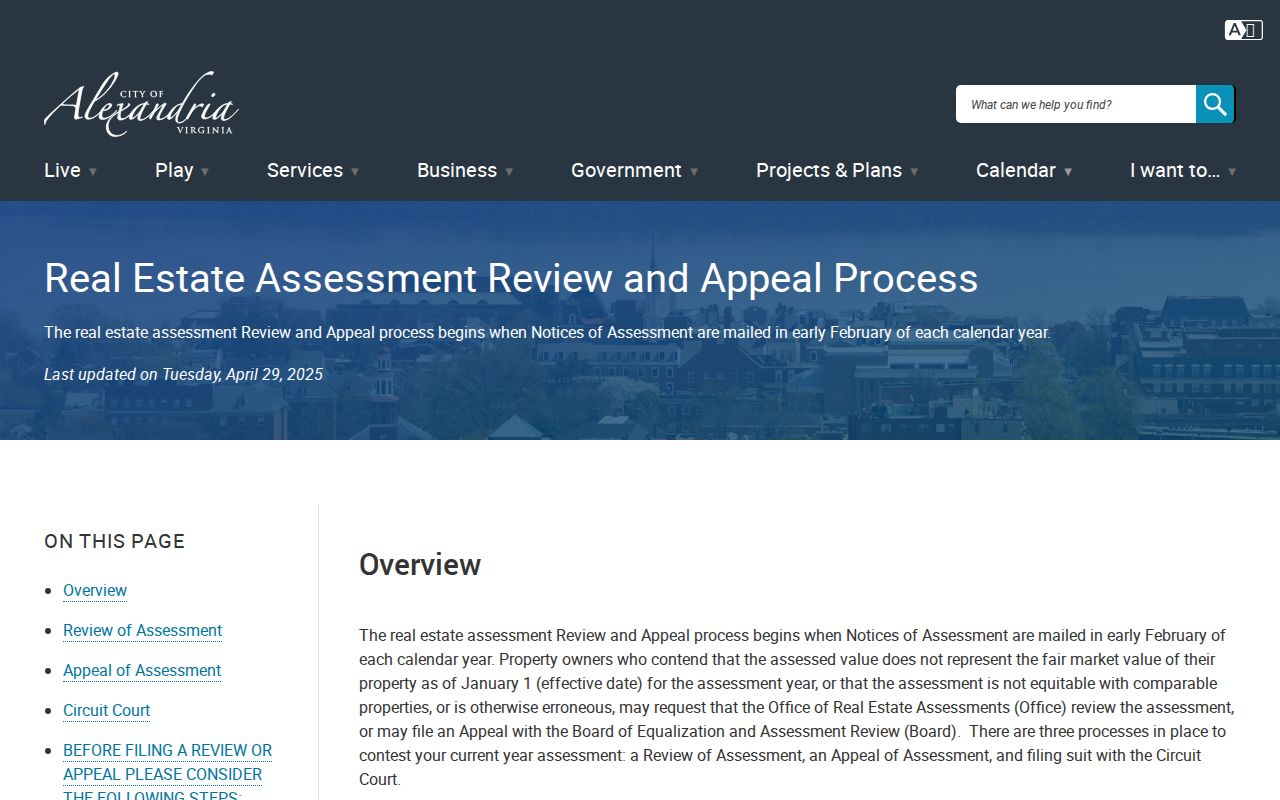
The Board is not the last word. After it hears and acts on an appeal, the City describes a Circuit Court remedy available within three years of the tax assessment year. Because the statutory route and filing deadline carry real stakes, a property owner should confirm both with qualified counsel.
Appealing an Alexandria Assessment
Build the file before you argue. Keep the assessment notice, property-detail fields, comparable sales, photographs, repair records, and any factual correction request together. Put everything in one place. The City urges owners to get the facts straight. Talk with the appraiser. Request internal review before taking a Board appeal. For a 2026 case, draw a line between sales used to support the assessment and the Board's pre-January 1 evidence cutoff. The annual notice and current Board form control the actual filing date. They also set the number of copies required.
Appeal window. Alexandria's review and Board appeal dates change by assessment year. Check the mailed notice and current Board instructions, and file the complete evidence package by the listed deadline.