
Alexandria Property Value Has More Than One Meaning
Alexandria property value has more than one meaning. A tax assessment and a deed's consideration are different measures. The assessment is a mass-appraisal estimate dated January 1. It is applied to every parcel on the tax roll. The figure in a deed belongs to one transfer, and its context can vary widely. Family transfers, gifts, assumptions, refinances, and nominal-consideration deeds all appear in deed records. They often look nothing like an ordinary market sale. Treat each number by its purpose. The assessor's appraisal answers the tax question. The recorder's instrument shows what actually changed hands.
| Value | What It Is | Where |
|---|---|---|
| Assessed value | City's tax-purpose estimate for the stated assessment year | Real Estate Assessment Search |
| Market value | Estimated fair-market value as of January 1 | Assessment methodology and appeal record |
| Sale consideration | Amount or consideration stated for a recorded transfer | Deed and recordation-tax material |
| Land / improvement | Separate value components in the property detail | Assessment record |
Alexandria sets assessments at 100 percent of estimated fair-market value each January 1. That is the legal level. A study ratio may fall below 100 percent. That means sales beat the prior assessments. No statutory discount or tax-rate adjustment is hiding in that ratio, so keep the assessment level, the study ratio, and the last recorded consideration apart.
Where Alexandria Property Value Appears in the Record
Real Estate Assessment Search opens with three lookup paths: address, account number, or map number. Pick one and select Property Details. The display can list the owner, situs and mailing addresses, land and improvement values, the total assessment, sales links, and Tax & Fee Info. Two comparison tools sit nearby. Primary Sales Comparables and Recent Sales & Other Transactions answer different comparison questions. Match the tool to the question. The assessment page owns its value fields. A tax bill applies the rate and is not an appraisal.
Timing matters here. The City refreshes assessment information each Friday and tax information every business day, while Clerk-derived sales can take roughly 30 days after recording to appear. A recent sale that seems missing from the assessment history may already have its deed on file, and the sales table simply has not caught up yet.
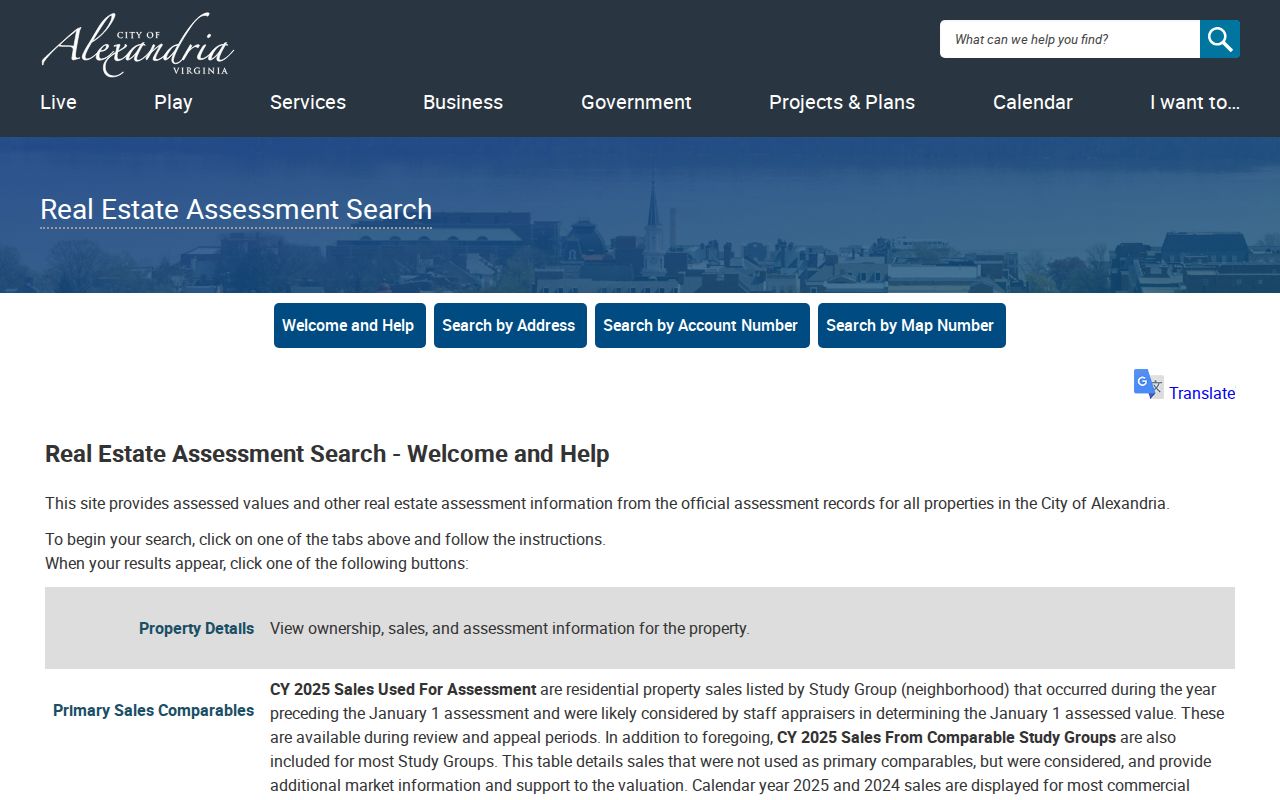
The City describes the search on its Real Estate Assessment Search page. Its welcome screen shows three parcel lookup paths.
When you copy an assessment total, copy its year too. A later value comparison only makes sense within the same cycle.
Alexandria Assessed Value Comes from Mass Appraisal
Mass appraisal works in steps. The City gathers property data, groups similar parcels, studies sales within each group, and compares prices with prior assessed values. Then it decides whether a group rises, falls, or holds level. The result covers many parcels at once. It is not a one-property appraisal ordered for a sale, and property details can include living area, lot size, land value, improvement value, and other physical characteristics.
Factual errors have a fix. An owner can ask the appraiser to correct a wrong field, and a review may include an interior or exterior inspection depending on the owner's wishes. Fixing a square-footage or lot fact is one thing. Contesting the fairness of the resulting assessment is another. Bring the physical facts, comparable sales, assessment year, and notice together when asking the office to review a value.
January 1 is the valuation date. The 2026 assessment drew on 2025 sales. A market shift after that date is not automatically reflected in the same year's value.
Alexandria Property Value Trends in the 2026 Report
The City's 2026 report tracks the averages citywide. The average existing residential assessment rose to $729,925 from $698,794 in calendar year 2024, a gain of 4.45 percent. Single-family homes averaged $1,001,336, up 4.06 percent. Condominiums averaged $447,612, up 5.63 percent. Across the 2025 cycle, 83 percent of residential properties increased, 1 percent decreased, and 16 percent held steady.
Averages describe the study, not a likely sale price for one home. A parcel can move differently from the citywide numbers because of its location, condition, size, characteristics, or sales group. Use the comparable sales attached to the subject record. Note the sales period the report used.
The City publishes its assessment report and valuation information online. The 2026 Board page limits appeal evidence to sales before January 1, 2026, while the FAQ notes that 2025 sales supported the assessment. Those two windows are not the same.
Alexandria Sale Consideration Is Not the Current Property Value
A deed often lists a consideration figure. Virginia's recordation tax keys off the purchase price or fair-market value. Alexandria layers on a city tax worth one-third of the state amount. The City's published state rate is $0.25 per $100 or fraction. For a specific filing, the current calculator gives the answer. A tax stamp is still useful. It can help you locate a transaction before the assessment sales table catches up. But it proves nothing about today's assessed or market value.
Consideration numbers mislead for another reason. Family transfers, gifts, assumptions, refinances, and exemptions all exist. Each can push the stated figure far from a market price. A deed of trust reflects a loan, not a sale. Before comparing any deed figure with an assessment or a public sales study, check the instrument type. Context matters too. Alexandria property records reward that caution.
For title questions, what matters is the deed's grantee and legal description. For the current assessment, the City's value fields govern. Does the transaction need a true market appraisal? Then a licensed appraiser's assignment is the right path.
Looking Up an Alexandria Assessed Value
Search by the parcel key. That habit prevents mixing up a nearby property with the one you actually mean. The assessment record carries the value fields, while the deed and the tax record supply separate evidence of the sale and the bill.
- Search the address in Real Estate Assessment Search.
- Open Property Details and note the assessment year, total, land, and improvement values.
- Open sales comparables and record their dates and comparison group.
- Use the deed to verify transaction consideration and legal description.
- Assessed value
- The City's value used to calculate real-estate tax.
- Market value
- An estimate of fair-market value on the January 1 valuation date.
- Consideration
- The amount or value attributed to the recorded transaction.
- Study ratio
- A comparison of sale prices with prior assessments in a study group.
Alexandria Comparable Sales Need a Date and Group
Primary Sales Comparables shows the sales the City used or weighed for its January 1 assessment work. 2025 material was available during the review and appeal period. Recent Sales & Other Transactions covers calendar 2025 and 2026-to-present entries in the study group. Commercial results appear citywide. Each output is a comparison source with its own date range and group. It is not a promise that a nearby sale predicts one parcel's value.
Before trusting any comparable, check the match. Property type, size, location, and other relevant characteristics all have to line up with the subject. A condominium average cannot stand in for a single-family average. Sales after the valuation date may shape a later cycle. They are not automatic evidence for the current assessment year.
When the conversation turns to exemptions, bill calculation, or filing an appeal, a separate resource applies. That is the Alexandria property tax records guide. This value page keeps the meanings of the numbers distinct.
What an Alexandria Assessed Value Does Not Tell You
An Alexandria assessment exists for taxation, not for pricing a sale. It is a mass-appraisal estimate pegged to January 1. Its study sales may come from an earlier window. It is also not an appraisal prepared for a buyer, lender, or other specific transaction. The legal level stays at 100 percent of the City's estimated fair-market value. A study ratio below 100 percent describes how prior assessments compared with sales. It is not a discount on the tax bill.
Value versus price. Use the assessed value for the City's tax record and a recorded deed for transaction evidence. When a current market opinion is needed, obtain a qualified appraisal.