
How an Alexandria Property Search Moves from Address to Record
Most Alexandria property searches begin in the City's Real Estate Assessment Search. Enter the street address there. Copy the account and map numbers from Property Details. Those numbers keep similar street names from getting tangled, and they bridge the assessment record to the tax account or map. The portal searches by address, account number, or map number. It offers no owner-name search. With only a person's name, use the Clerk's grantor-grantee index or another official source instead. A partial address match is never proof of ownership.
- Search the address in Real Estate Assessment Search.
- Open Property Details and note the owner field, account number, map number, and sales links.
- Use the latest recorded deed in COVERS to confirm the grantee and legal description.
- Follow Tax & Fee Info for the bill, then use the map number in Parcel Viewer.
- Request a Clerk copy when the document image or certified record is needed.
Alexandria Property Search Uses Address, Account, or Map Number
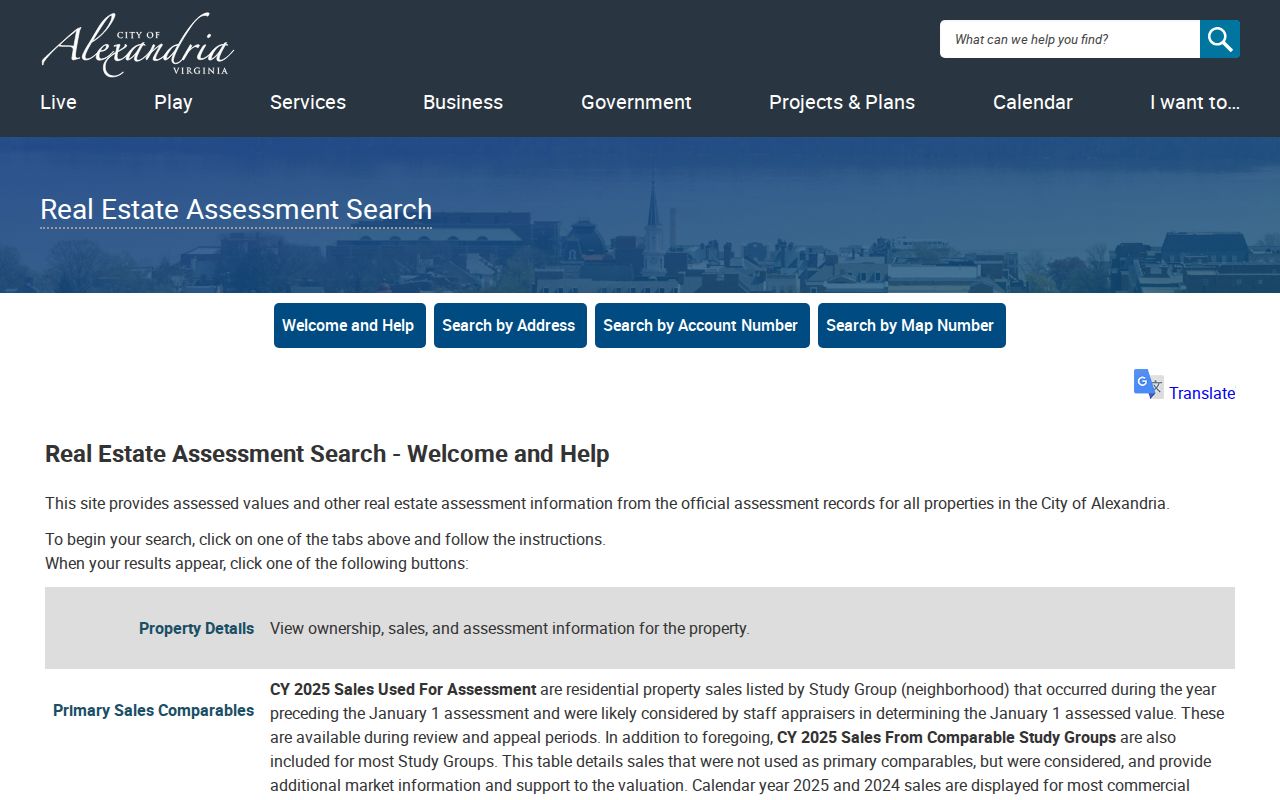
The assessment search screen offers three starting modes. Address works when you know the location. Account number is the assessment record key. Map number ties a parcel to the City's tax-map scheme and its GIS layer. A result can open Property Details, Primary Sales Comparables, Recent Sales & Other Transactions, Tax & Fee Info, and GIS controls. Save the identifier and the displayed date whenever you keep a result.
| Mode or control | What it helps locate | Useful follow-up |
|---|---|---|
| Address tab | Known street address or situs | Save account and map number |
| Account Number tab | Assessment account | Open Property Details and Tax & Fee Info |
| Map Number tab | Tax-map parcel reference | Compare with the GIS parcel |
| Property Details | Owner, sales, and assessment information | Check record dates and deed reference |
The City labels these controls on its assessment search page. The welcome screen displays the three search tabs.
Result dates are not interchangeable. Assessment details refresh weekly as of Friday. Tax information updates each business day, while Clerk-derived sales can take about 30 days to appear in the assessment sales table.
What an Alexandria Property Search Result Shows
Property Details is the core assessment record. It links an owner name to situs and mailing addresses, parcel identifiers, values, and sale history. A mailing address may sit outside Alexandria or serve several parcels. Keep it separate from the situs. The situs describes the property being assessed. A name on the roll is the tax-roll owner, not proof of who occupies the place and not a title opinion.
| Owner | Name carried on the assessment record |
|---|---|
| Situs / mailing | Property location and tax correspondence destination |
| Account / map number | Keys for assessment, tax, and GIS cross-checks |
| Land and improvement | Components of the assessed value |
| Sales history | Assessor transaction entries, subject to lag |
| Tax & Fee Info / GIS | Links to bill details and parcel map context |
Treat a result as a starting inventory. A recorded deed carries the instrument and legal description, and the roll can lag behind a new conveyance. When fields disagree, compare dates and parcel keys.
Alexandria Property Search Can Lead into COVERS
Once an assessment record points to an owner or sale date, the Clerk's land-record index can locate the deed behind it. COVERS is the Virginia court system's land-record channel. Deeds, deeds of trust, releases, and judgments all run through it. A free index hit differs from image access. Remote subscribers can search, view, and print images. Courthouse terminals are the in-person fallback. Before relying on a hit, record the instrument type, party names, record date, document reference, and legal description.
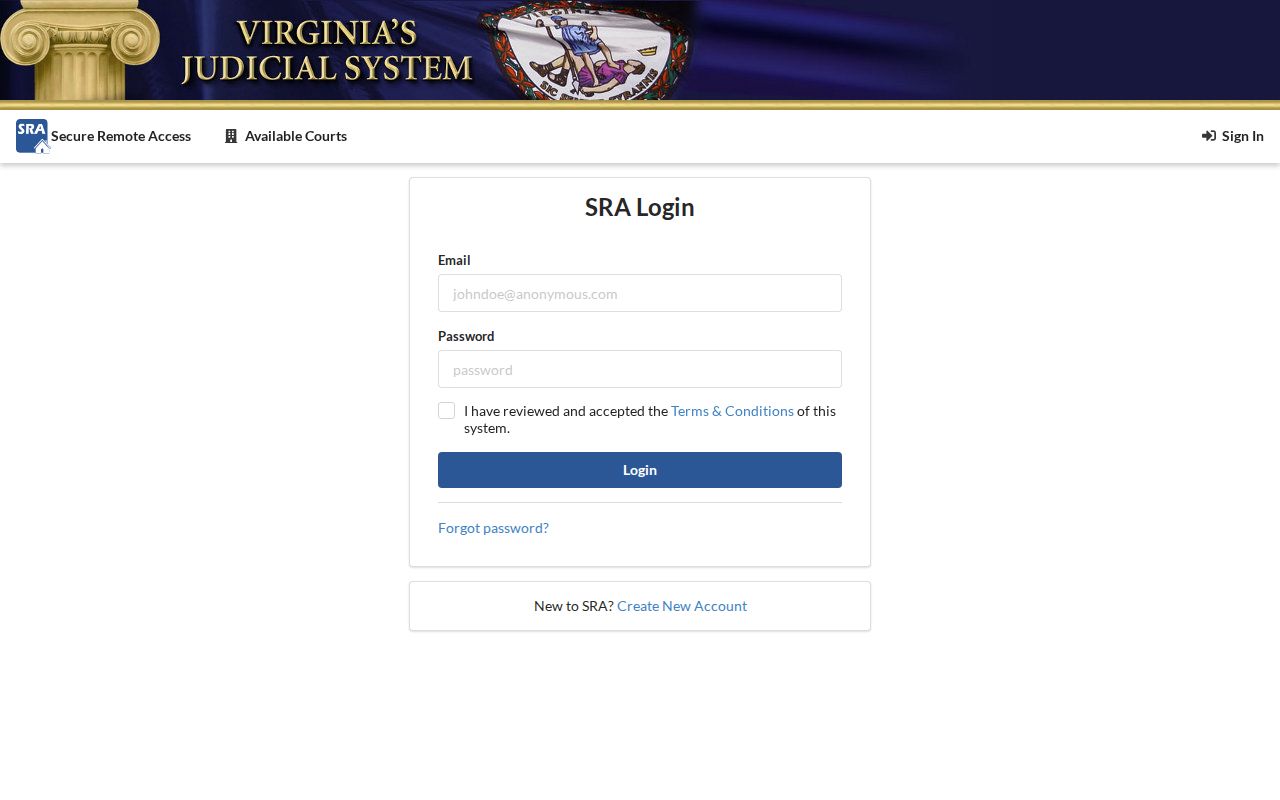
The Clerk posts the remote COVERS access route. The sign-in screen marks the entry point.
Alexandria's online land-record coverage is patchy. The Clerk lists books and microfilm through October 1993, and a short online span covers January 1785 through 1798. Online coverage also picks up after January 1930. A gap in the remote index is not a verdict. It calls for an older index or book search. It is not a conclusion that a transfer never happened.
What an Alexandria Property Record Shows
An Alexandria assessment result is a tax-roll snapshot. It carries physical characteristics and value fields. The Clerk's index adds the recorded transfer trail. Reading both beats treating one search as a complete property file, because the assessment portal handles valuation and parcel lookup while the deed index identifies instruments and parties.
| Owner of record | Tax-roll name shown in Property Details |
|---|---|
| Situs / mailing | Parcel location versus tax correspondence address |
| Account / map number | Assessment and map reference keys |
| Assessed value | Land, improvement, and total value for the stated year |
| Legal description | Recorded lot or other description to compare against the deed |
| Last sale | Assessor transaction entry, which can lag recording |
A search result does not establish clear title. Nor does it prove a mapped line is surveyed or reveal every private agreement affecting a lot. Title questions need an examination; boundaries need a survey.
Alexandria Property Search Results Carry Different Dates
Alexandria refreshes its assessment data on three different clocks. Assessment information updates each Friday. Tax information updates every business day. Clerk-derived sales, by contrast, can take roughly 30 days after recording before they surface in a property search result. These are source-specific rhythms. A newer deed can name the grantee first. That lag matters in Alexandria deed records.
Read Primary Sales Comparables and Recent Sales & Other Transactions as two separate views. The first covers sales in the assessment study group. The second lists transactions for a stated period, with commercial material shown citywide. Save the sale date and property type too. A nearby sale is not automatically comparable. An entry may not be an arm's-length sale, and it is rarely the final measure of value in an Alexandria appraisal.
Keep a small evidence note as well. Record the query date, result date, address, account number, map number, and instrument reference from the property records. If owner names differ, compare the deed's recording date against the assessment refresh date, since the assessor's portal governs the tax roll while the Clerk decides whether a deed was recorded. For ownership questions, the Alexandria owner lookup guide explains how these deed and assessment records fit together.
Alexandria Property Search Cross-Checks Maps and Permits
The map number links assessment results to Parcel Viewer. There, parcel shapes, zoning, aerial imagery, and linked plats supply spatial context. The viewer links back to assessment details. That loop lets one account reconcile a map with the tax roll. A visual boundary may conflict with the deed. Treat the map as a location clue. For a real boundary answer, consult the recorded plat or a surveyor rather than the screen.
APEX adds a separate permit work-history search. Public fields cover permit number, project name, permit type, status, parcel number, address, and application, expiration, or finalized date ranges. A permit may explain a changed assessment. But an applicant or contact is not always the owner of record. Public search runs without login. Do not assume account-only export and payment functions extend to every visitor.
Keep each item as separate evidence. Set the assessment entry, deed, tax bill, GIS parcel, and permit status side by side. For an old property, a city directory can bridge a historic street number to a modern address, though the deed and legal description remain the ownership reference in Alexandria property records.
Alexandria Property Search Begins with the Right Jurisdiction
An Alexandria mailing address does not always mean an Alexandria City parcel. The Alexandria portion of Fairfax County is different. Fairfax offices assess and record that property. The City's property search can return no match even though the mailing city says Alexandria. Treat a no-result screen as a prompt, not a verdict. It asks you to verify the legal locality. It does not ask you to conclude that a property record is missing.
Start with the street address and parcel location on the Alexandria assessment map. A parcel outside the independent city belongs in Fairfax systems. Use Fairfax assessment and Circuit Court records there. A ZIP code is not a legal boundary. Neither is a neighborhood label or post-office name. The City Parcel Viewer helps orient a location. But its lines are informational. They never settle jurisdiction or parcel rights.
Inside Alexandria, try the address mode first. Then preserve the account and map numbers. When a name is the only key, note that the public assessment interface offers no owner-name search. Use COVERS and its grantor or grantee roles instead. A name match still needs the land description. That confirms it points to the right parcel. For a suspected old house number, check a directory or deed for the historical street reference. Then return to the current assessment parcel before equating two addresses.
This sequence keeps a bad search key from looking like a records gap. It also stops an Alexandria postal address from steering you to the wrong Clerk or assessor.
Alexandria Property Search by Address, Owner, or Parcel
Pick the key that fits what you already know. An address works best for a known Alexandria property. Account and map numbers are stronger when an earlier result gives you a stable identifier to reuse in a property search. Owner names matter in the Clerk's deed index. There, grantor and grantee roles sharpen the match, though common names and trust or entity vesting can still return several candidates in Alexandria property records.
| Search Key | Best For | Where It Works | Watch Out |
|---|---|---|---|
| Address | A known situs | Assessment Search and Parcel Viewer | Check unit, direction, and historic street name |
| Owner name | Recorded parties or a deed chain | COVERS grantor-grantee index | Check trust, LLC, estate, and same-name possibilities |
| Account or map number | An exact parcel match | Assessment, tax links, and GIS | Keep the identifier with its source and date |
Not a title search. An Alexandria property search gathers public assessment, deed, tax, map, and permit clues. It does not guarantee clear title or settle a boundary; use a title professional or surveyor for those questions.